
Why I stopped treating AI blog drafts as the thing to fix
I used to think writing blogs with AI was a battle for the perfect prompt. But a draft that worked once would drift on the next run. The change that held wasn't a longer prompt—it was separating my editing standards from the run workflow while building a 19-post library for Le J' Cafe.
Context & Setup
In June 2026, I faced a significant content distribution challenge for Le J’ Cafe—a specialty coffee roaster based in Vietnam. At the time, Le J’ had 14 active specialty coffee products across 9 core variety categories (Catimor, THA-1, Red Bourbon, Gesha, Centroamericano H1, Fine Robusta, and more).
The objective was highly specific: build a comprehensive 19-post Vietnamese knowledge library on Le J’s news blog (built on Shopify).
- The first 9 posts mapped directly to the 9 active coffee varieties, explaining their biological lineage, history, and taste chemistry.
- The remaining 10 posts expanded the network—covering genetic families, Arabica genealogy, and unique domestic varieties—making the entire specialty coffee landscape highly discoverable for Vietnamese coffee lovers.
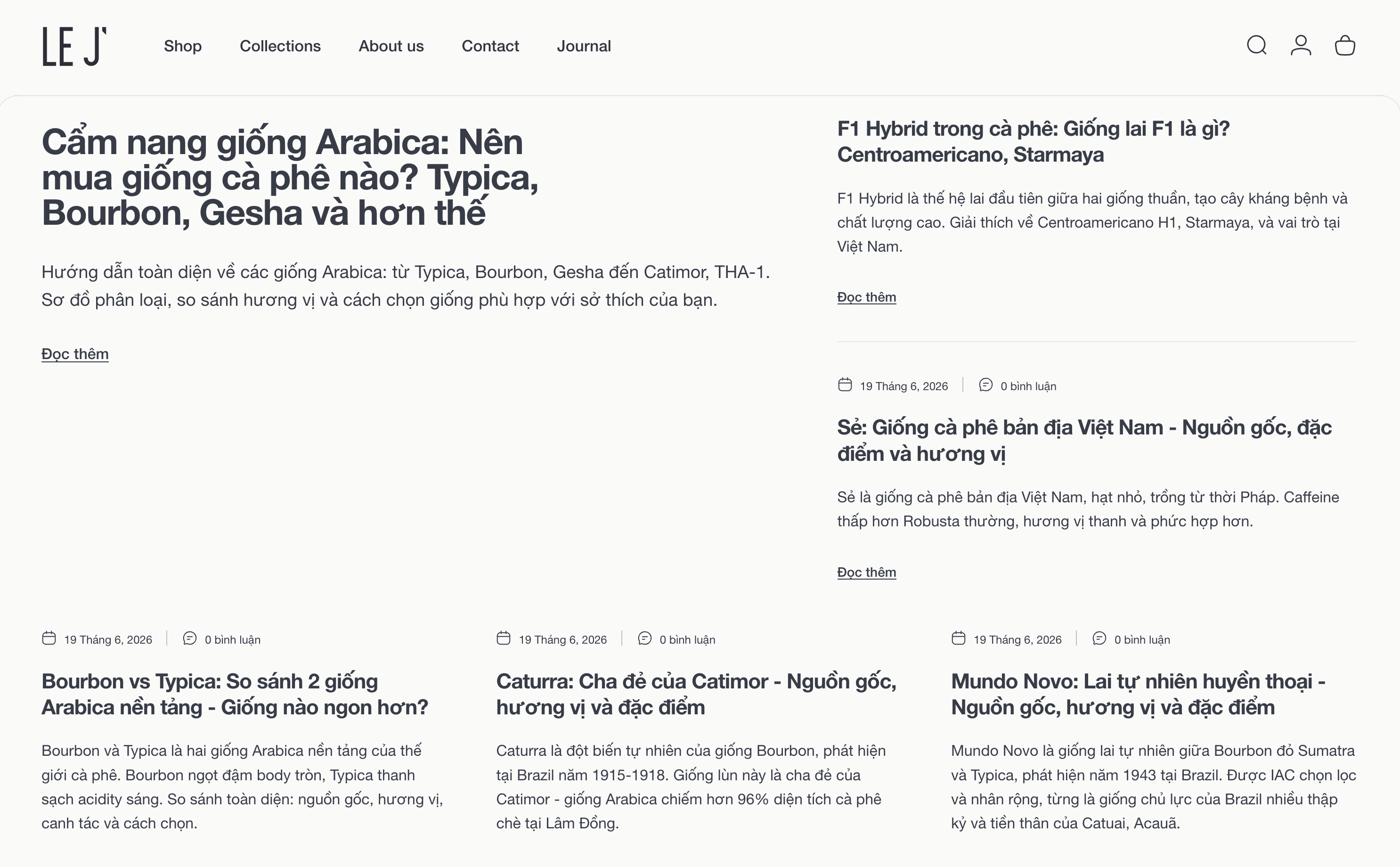
Browse the live library at Le J’ Journal.
Every single article had to meet strict Next-Gen search (GEO/SEO) standards: answer the reader’s intent directly, cite exact biological facts (zero hallucinations allowed), maintain a clean, natural Vietnamese voice, and seamlessly link to the purchase pages of Le J’s actual products.
The Obstacles
I had Hermes Agent ready to automate the execution. But as I began the campaign, my immediate impulses led straight into three costly dead ends:
- Prompting harder: Whenever a draft came back weak, I added more rules to my system prompt. I crammed everything—biological details from World Coffee Research (WCR), genetic diagrams, syntax constraints (sentence length, avoiding AI clichés), and product insertion criteria—into one giant block of instructions. But the longer the prompt grew, the more the agent suffered from “attention decay,” dropping critical rules. At one point, a GEO research subagent even timed out at 600 seconds trying to process too many raw documents at once.
- Silent manual editing: When a draft returned with generic AI phrases (“furthermore,” “nevertheless”) or minor biological inaccuracies, I’d quietly patch the markdown file myself. It solved the immediate Catimor or THA-1 post in five minutes, but the exact same errors returned on the second and third articles. I had made myself the permanent cleanup crew for the AI, while the underlying pipeline remained fragile.
- Full automation without checkpoints: To speed up the remaining 10 genetic/family articles, I tried giving the agent titles and letting it write start-to-finish with zero manual checkpoints. The files were produced instantly, but they were devoid of the passionate, authentic voice of Le J’s real-world roasters.
I realized my core mistake: I was conflating the editorial question “How should this category of writing be written?” (The Approach) with the mechanical execution “What steps do we take, and in what order?” (The Workflow). Trying to force both into one active chat window was causing severe prompt drift.
The Shift: Two-Tier Pipeline
I decided to pull quality control entirely upstream. I split the content engine into two completely independent layers.

Tier 1: The Approach (Editorial Standards) - Defining “Good”
Instead of writing a complex writing prompt, I wrote a short, separate specification document for the “variety” post type (coffee-variety-geo-blog):
- Data: Bounded source files only. The agent could only pull facts from official botanical databases (World Coffee Research, WASI) and active product/social media captions from Le J’. It was strictly forbidden from guessing.
- Goal: GEO-optimization. Answer specific consumer queries first, then link to the exact purchase page of Le J’s corresponding coffee bag.
- Write: First-person “I”, blunt, short sentences. I loaded my native Vietnamese writing skill (
vietnamese-writer) to strip out translation artifacts and complex clauses. - Check: A rigid binary checklist (no sentences over 30 words, zero em-dashes, zero banned AI words).
Tier 2: The Workflow (Mechanical Execution) - Orchestrating the Run
Once the Approach document was saved, running 19 articles became a systematic process:
- I logged every post in a tracking sheet (Inventory).
- When triggered, the main Hermes Agent functioned as the “Editor-in-Chief” (Main Thread). It spawned independent child sessions (Subagents) for each write request.
- Every child agent received a completely clean context window—receiving only its dedicated botanical data and the Tier 1 Approach standard.
- The subagent submitted its draft. The Editor-in-Chief checked it against the strict layout and voice rules. Passing articles were approved; failing drafts were rejected with specific corrections and rewritten.
Debugging the System, Not the Prose
This pipeline wasn’t magic from day one. When we uploaded the very first live post (Catimor) directly to Shopify on June 19, we hit two immediate layout failures:
- Double H1 Title: Mobile screens displayed duplicate titles because our markdown header clashed with Shopify’s layout header.
- Leaked Frontmatter: The raw metadata block (YAML code) was displayed as plain text at the top of the published page because of a regex compilation error in our publishing script.
Instead of logging into the Shopify CMS to edit these errors by hand, I pulled the failures back to Tier 1. I modified the regex compiler and added a “strip H1” rule to the Approach spec, then ran our publishing script (publish_blog.py) again. The system automatically rewrote and re-uploaded all 19 files via Shopify’s GraphQL API.
The most powerful byproduct of this system: It doesn’t replace the creator. It shifts you from a tired copy-cleaner into an active Editor-in-Chief—allowing you to focus strictly on creative angles, factual integrity, and the final greenlight, while the machine handles the heavy lifting.
The Delegation Blueprint (Prompt)
If you have a terminal-capable agent and want to stop fighting voice drift across your active chat sessions, turn your agent into an Editor-in-Chief with this blueprint prompt:
I want you to act as an "Editor-in-Chief" executing a two-tier content drafting pipeline:

1. First, create a durable editorial standard file `approach-coffee-variety.md`:
   - Data: Use only verified botanical source documents from World Coffee Research combined with raw Instagram captions or product listings from our store. Do not hallucinate taste specs.
   - Goal: Guide the reader to clearly distinguish this coffee variety, and provide the exact direct link to the corresponding product page in our shop.
   - Write: Write in a grounded, authentic first-person "I" voice. Never use sentences longer than 30 words. Completely ban: "furthermore," "nevertheless," "in conclusion," "not only but also."
   - Check: Confirm zero use of em-dashes; technical terms must remain in standard English (SL34, F1 Hybrid); every variety post must end with a product link.

2. Configure a multi-agent Workflow:
   - Read my active post inventory file.
   - For each post item, open a fresh, isolated child session (or spawn an independent subagent).
   - Inject the `approach-coffee-variety.md` as the supreme system directive for the child session to write the first draft.
   - Receive the draft back and act as the quality checker, strictly auditing the text against the "Check" section guidelines. Reject any draft carrying lazy AI formatting.

Acknowledge that you understand this two-tier editorial architecture, and let me know what format you need my initial post inventory list to be in.
Let’s Figure Your Workflow Out
Automating your writing is not about chasing a hands-off system that runs completely without you. It is about automating mechanical repetition so you can save your energy to upgrade your creative standards.
If you are eager to build a high-quality knowledge base for your brand, or struggling to orchestrate clean subagents and publishing APIs on your machine, let’s untangle it:
- Discord:
annguyen175(Or send a direct message via this link) - Email:
[email protected] - Facebook Discussion Group: vnhermesagent
Tell me what you are writing about, where the production bottleneck gets frustrating, and what your drafts are missing. I’ll research your setup, set it up on my hardware first to test, and return with a tested, robust blueprint for you.