
ChatGPT cited our Dalat coffee brand. The 20-day playbook to survive LLM search.
Le J' was buried on page seven for 'Dalat specialty coffee' on Google. Within twenty days of deploying a structured, varietal-first GEO pipeline, real-time AI engines began sourcing our products. Here is our honest first-person record—and the limits we hit.
The baseline: Hidden at the bottom of the funnel
In late May 2026, Le J’ Coffee—a small, independent roastery in Da Lat—was practically invisible to generative search. When we queried ChatGPT, Gemini, or Perplexity for “Dalat specialty coffee” or “best Vietnamese single-origin,” the recommendations bypassed us entirely.
A traditional search engine audit showed why: for our core categorical targets, the domain sat around page seven in Google’s index.

This wasn’t a failure of product quality or copy. Le J’ had detailed botanical and processing details for all 14 active products. The breakdown was structural: the site was optimized for human aesthetic browsing, not machine ingestion. To a generative parser, our unstructured stories were noise.
Why standard SEO advice failed the AI test
The typical advice for improving this visibility would be:
- Write more broad-intent content (e.g., “The Ultimate Guide to Da Lat Coffee”).
- Increase backlink domain authority (begging lifestyle blogs for redirects).
- Double down on social volume to drive branded searches.
None of these tactics touch the mechanics of LLM extraction. Generative search engines do not crawl the web in real-time during a conversation. They read from processed snapshots, chunk content at 128-token boundaries, apply query-focused reranking, and filter for high-density entities.
If your technical details—variety, process, elevation, and terroir—are buried in romantic, paragraphs-long prose, the cross-encoder RAG models discard them as low-signal junk.
The structure: Designing for Run-Time RAG survival
We built a structured coffee-education library on Le J’ featuring 19 long-form articles mapped directly to specific varietal and process queries. We discarded general narrative copy and rebuilt the layout under several hard constraints to survive what is technically called Run-Time RAG—the live browser retrieval process where chatbots read, chunk, and score pages on the fly during a conversation:
- Answer-first visible page leads: The opening line of every page directly answered the core query (no throat-clearing sentences).
- Standalone H2 Q-A chunks: Every subheading was framed as a natural-language question. The paragraph beneath it was capped under 150 words and sat completely isolated (no relative references like “as mentioned above”).
- Dense entity profiles: We explicitly bolded primary botanical terms, farm domains, and exact SCA scores.
- Valid FAQPage JSON-LD schemas: Every Q-A pair was explicitly injected into the head markup to serve as a low-resistance parsing signal.
The evidence: Precise questions win citations first
Within roughly twenty days of publishing the database, we captured our first live citations. The breakthrough did not happen on general-intent queries like “specialty coffee shop in Da Lat.” It landed exactly where the search intent was commercial and highly specific.
1. The variety-focused shopping query (ChatGPT)
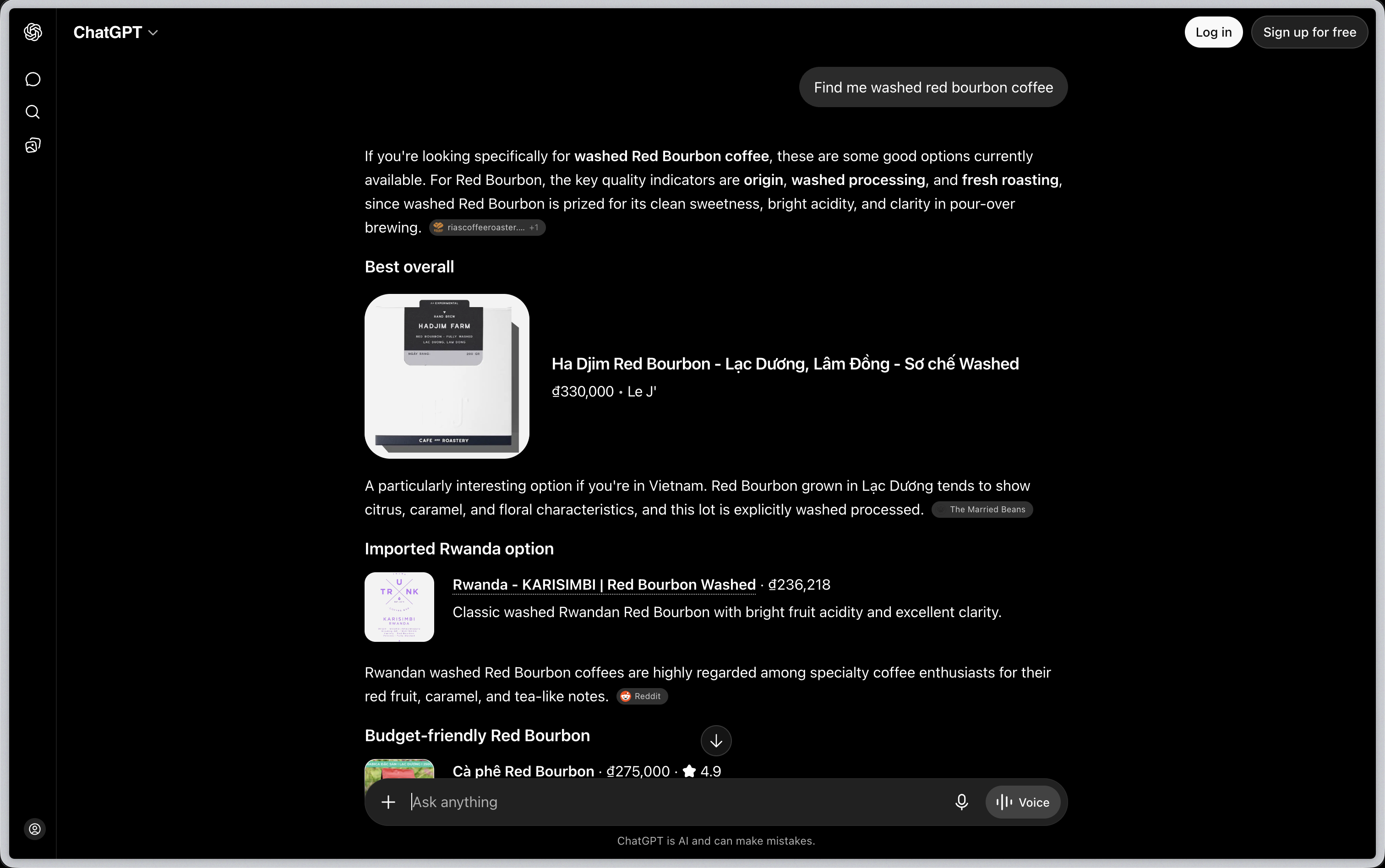
When asked, “Find me washed red bourbon coffee,” ChatGPT bypasses traditional reviews and pulls Le J’ directly into its “Best overall” recommendation block. It cites the exact variety, origin (Lạc Dương), processing method (Washed), price (₫330,000), and links directly to the product.
2. The local-terroir query (Gemini AI Mode)
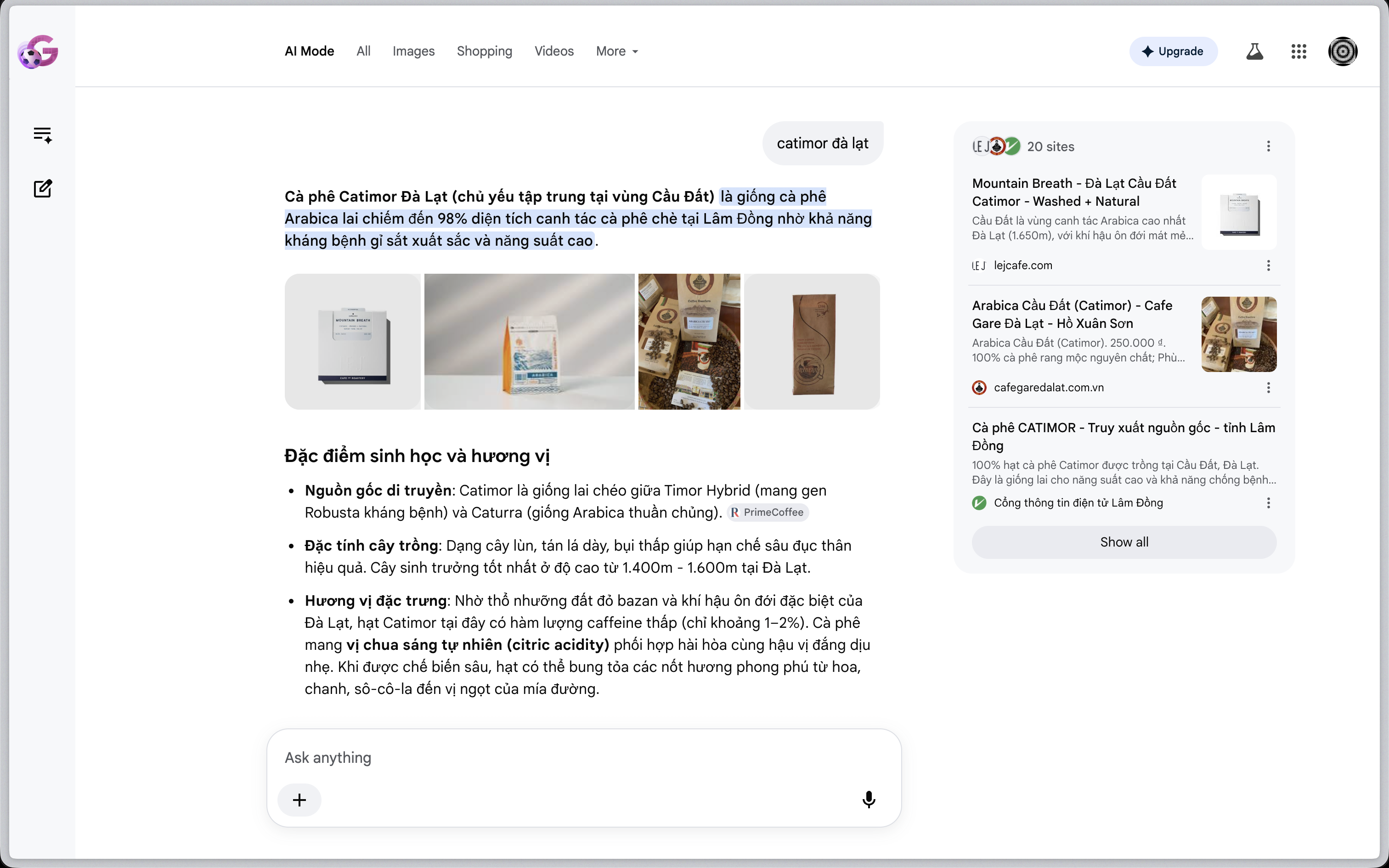
When asked about “catimor đà lạt” (Dalat Catimor), Gemini’s AI Mode cites Le J’ Mountain Breath - Đà Lạt Cầu Đất Catimor within its 20-source grounding panel, extracting both the washed and natural processing details.
Understanding the boundaries of the signal
We are not claiming victory over Google or a permanent place on ChatGPT’s homepage. These are point-in-time observations.
When we test generic terms, the results are much weaker:
| Query Type | Query Example | Cite Rate | Competitor Density |
|---|---|---|---|
| High Intent (Specific) | “washed red bourbon vietnam” | High | Low (unstructured competitors) |
| Medium Intent (Local) | “catimor đà lạt” | Moderate | Medium (regional roasters) |
| Low Intent (Generic) | “cà phê specialty đà lạt” | Low | Very High (large established brands) |
Broad queries carry massive competitor density and authority bias. A small business with a fresh site cannot compete there initially. The strategic win is to own the high-intent, long-tail queries where buyers are looking for a specific bean, process, or preparation.
Traffic is context, not direct proof
During the month we ran these changes, our analytics recorded notable natural growth:
- Direct sessions: 873 (up 33% month-over-month)
- Search sessions: 324 (up 7% month-over-month)
- Social sessions: 204 (down 21% month-over-month)
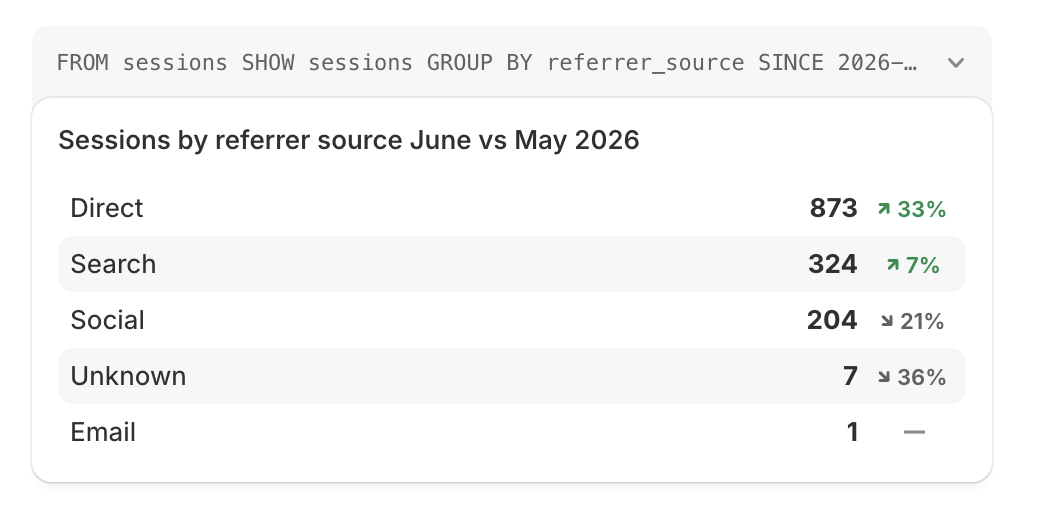
While it is tempting to attribute the traffic bump directly to our new AI citations, we cannot. Generative search engines rarely pass clean referral headers; many AI clicks register as “Direct” or “Unknown.” Furthermore, twenty days is too narrow a window to isolate our changes from repeat customers, regional tourism, and organic Google search lift.
The screenshots are our only verifiable evidence of citation success. The traffic figures simply justify continuing the experiment.
The next measurement phase
Our immediate focus has shifted from publishing new pages to tracking structural durability. We are logging target queries in a dedicated index sheet twice a month to monitor:
- Citation decay: Does ChatGPT drop our products when a competitor updates their page?
- Schema drift: Did standard Shopify updates silently wipe the JSON-LD schemas?
- Freshness decay: How quickly does Gemini lose interest when
dateModifiedslips past 90 days?
GEO is not a setup-and-forget task. It is a continuous operational cycle of finding the questions your product answers uniquely, rendering those answers in machine-survivable shapes, and verifying the published code remains live.
Build the workflow into your setup
We packaged the exact automation workflow we ran for Le J’ into the GEO Skill Pack. It contains three focused Hermes Agent skills built to audit site pages, optimize templates for high-density extraction, and watch for schema regressions.
If you are running an independent business with deep expertise but zero AI visibility, let’s look at your pages together:
- Discord:
annguyen175(Direct link: annguyen175) - Email:
[email protected] - Facebook Discussion Group: vnhermesagent